About Me

Hello!
My name is Thomas (Korbin) Waters. I am a first-generation PhD candidate at the University of Michigan, Ann Arbor,
in the Astronomy & Astrophysics program. My primary research interests are in supermassive black holes and their broad
impacts on galaxy properties and evolution.
Academic Journey and Inspiration
My academic journey in astrophysics started following my service in the United States Marine Corps as an infantryman
with the 1st Light Armored Reconnaissance Battalion. I began at South Seattle Community College in Seattle, Washington,
initially aspiring to a career in astronautical engineering. However, after attending my first few physics classes, I
quickly shifted my focus to astronomy. My professor, Dr. Abigail Daane, was an incredible instructor who deeply inspired
me to work towards a career in astronomy. Under her guidance, I received the Ready, Set, Transfer! (RST) Academy
scholarship and began a capstone research project on measuring the mass of our local supermassive black hole,
Sagittarius A*. I was instantly hooked on research the moment I started the project. Moreover, the first time I saw
the results, after months of analysis, I was filled with a sense of accomplishment and wonder that I had never
experienced before. I knew then that my calling was to be a researcher.
Undergraduate Research
After obtaining my Associate of Science degree, I transferred to the University of Washington, Seattle, where I majored
in astronomy and comprehensive physics. In my first quarter, I joined the Pre-Major in Astronomy Program (Pre-MAP),
a class aimed at introducing students to programming and astronomy research. I was paired with Dr. Meredith Rawls and
was introduced to analyzing data from the Dark Energy Camera (DECam), used as a precursor for the Vera C. Rubin
Observatory Legacy Survey of Space and Time (LSST). This experience was one of the highlights of my undergraduate
research as I got my first taste of doing cutting-edge research in astronomy and I gained the foundation of programming
skills that have been essential throughout my career. After Pre-MAP, I was fortunate to be accepted to work with Dr.
Jessica Werk and her team, called the Werk SQuAD (Student Quasar Absorption Diagnosticians), on projects understanding
the circumgalactic medium (CGM) around galaxies, and, as an extension to this, I also worked with Dr. Yakov Faerman on
the properties of cool CGM. Drs. Werk and Faerman were incredible mentors who taught me the importance of collaboration
and the value of a supportive research community.
Summer Internships
In addition to research at the University of Washington, I attended two summer internships that were pivotal to my
development as a researcher. The first was at Caltech in Pasadena, California, where I worked with Dr. Kishalay De,
who was a graduate student at the time, and his advisor, Dr. Mansi Kasliwal, on a project that aimed to optimize their
source detection pipeline for Near-Infrared (NIR) data, which contains the unique challenge of having correlated pixel
noise. The second internship I attended was at the Harvard & Smithsonian Center for Astrophysics in Cambridge, Massachusetts,
where I worked with Dr. Razieh Emami to model galactic gas in the IllustrisTNG TNG50 simulation, which resulted in the
publication of my first-ever first-author paper. These internships and my research at the University of Washington solidified
my passion for research and my desire to pursue a career in academia. I then set my sights on completing my PhD.
Current Research and Future Aspirations
After graduating from the University of Washington, I was accepted into the PhD program at the University of Michigan,
Ann Arbor. Here, I work with Dr. Kayhan Gültekin. I am currently engaged in a project that aims to measure the mass of a
collection of supermassive black holes to expand critical galaxy scaling relations. Details of my ongoing research can be
found in the Research section!
I am incredibly fortunate to have had unique opportunities and continue to work in a field I am deeply passionate about. I
intend to continue my career in astrophysics research, aiming for a postdoctoral position after completing my PhD,
leading to a research role at an astrophysics research institution. I am also more broadly interested in data science and
scientific computing. I intend to complete the University of Michigan's Data Science Certificate program to gain a more
robust foundation in data science and scientific computing to complement my research skills.
A Personal Note
Outside of research, I love spending time in nature. My favorite activity is rock climbing, both indoors and outdoors,
but I also enjoy hiking, camping, and backpacking. I also enjoy running, biking, and swimming (admittedly much less than
my other, more relaxing hobbies) but I am currently training for a triathlon! I am trying to make an effort to stay in
shape by, of course, choosing to do something incredibly difficult (the story of my life!). I also have a plethora of hobbies,
including playing the guitar, creating stained glass, reading books (Stephen King and J.R.R. Tolkien are my favorites),
and playing video games. I am a huge fan of RPGs and any game, really that has a compelling story. I am also an avid cook. I
love making all types of food, especially Italian, and I pride myself on making my own recipes. I try to give myself the time
to relax, do things that I enjoy, and spend time with the people I love. I believe that this is essential to being a good researcher!
Get in Touch
I am always open to collaborative opportunities and discussions about astrophysics. Feel free to reach out to me via the
contact form linked in my Contact section. There, you will also find links to my LinkedIn, ORCID,
GitHub, a search on NASA ADS for my publications, and a link to download my CV. I look forward to hearing from you!
Research
My current research revolves around the measurement of supermassive black hole (SMBH) masses using stellar
dynamics. By studying the motions of stars influenced by the gravitational potential of SMBHs, we can infer the mass of
these objects as well properties of the stellar and dark matter components of the galaxy. This work not only helps
understand the behavior and characteristics of SMBHs but also provides insights into galaxy formation and evolution,
galaxy-black hole co-evolution, and can lead to placing constraints on black hole seeding mechanisms.
Current Work
My current research focuses on developing and applying stellar dynamical techniques to measure
supermassive black hole (SMBH) masses, with particular emphasis on low-mass galaxies where
dynamical measurements remain scarce. By combining high-resolution imaging from the Hubble
Space Telescope (HST) with integral-field spectroscopy from the Multi Unit Spectroscopic
Explorer (MUSE) on the Very Large Telescope (VLT), I use Schwarzschild orbit-superposition
modeling to constrain black hole masses and investigate the coevolution of galaxies and their
central black holes. These measurements help extend black hole scaling relations into the
poorly sampled low-mass regime, providing important constraints on black hole formation,
galaxy evolution, and future gravitational-wave sources observable by missions such as the
Laser Interferometer Space Antenna (LISA).
In parallel, I develop computational tools and methodologies for stellar dynamical analysis.
My open-source Python package,
kinextract,
provides modern tools for extracting line-of-sight velocity distributions from galaxy spectra while emphasizing reproducibility,
robust uncertainty estimation, and flexible analysis workflows. I am also developing new statistical methods for uncertainty
quantification and regularization that improve the reliability of stellar dynamical black hole mass measurements.
Notable Results
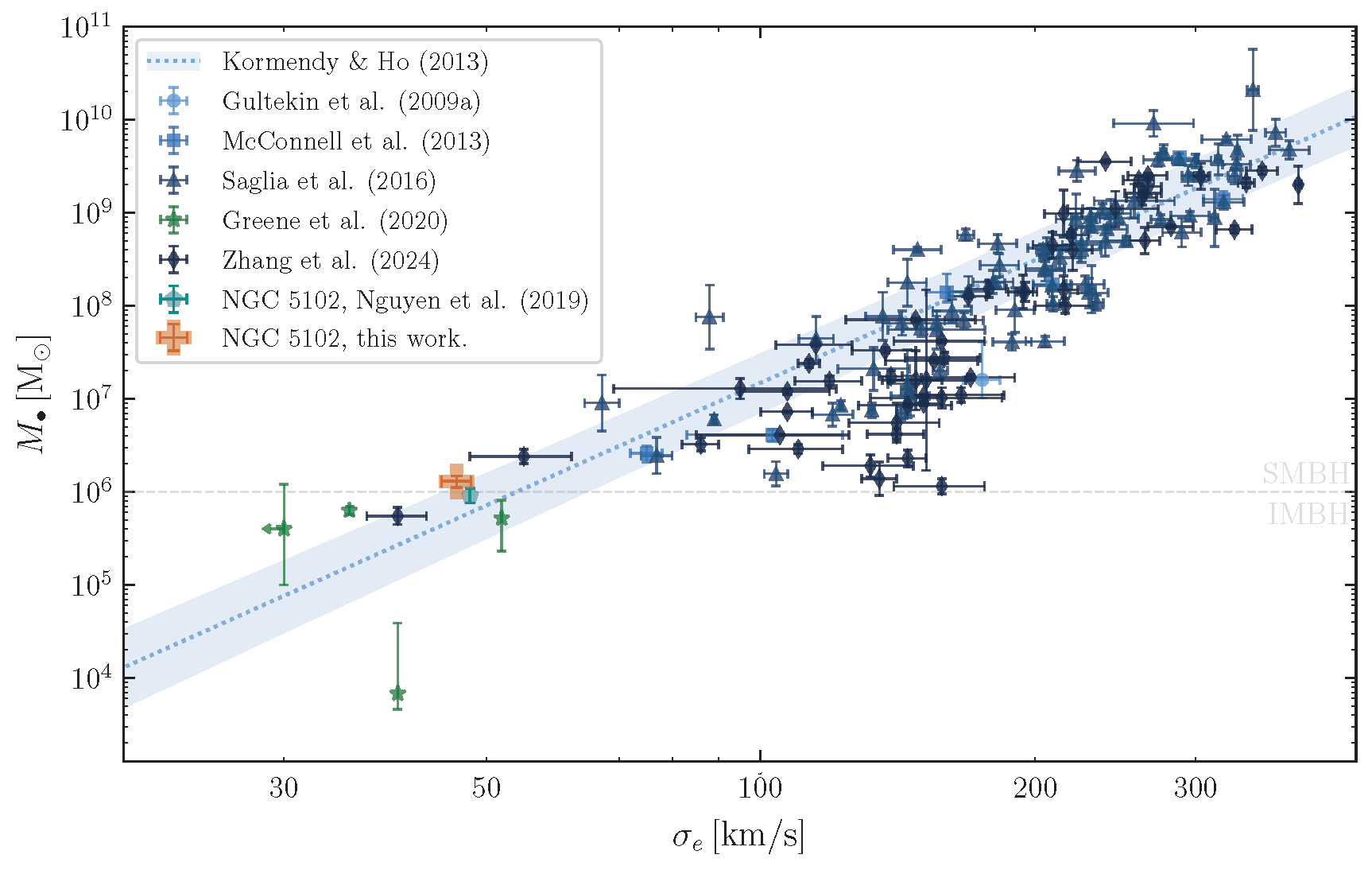
A Supermassive Black Hole Mass Measurement in NGC 5102 with Schwarzschild Orbit-superposition Modeling
We measured the mass of the central supermassive black hole in the nearby lenticular galaxy
NGC 5102 using stellar dynamical modeling. By combining high-resolution spectroscopy from
the Hubble Space Telescope Imaging Spectrograph (STIS) with integral-field spectroscopy from
the Very Large Telescope Multi Unit Spectroscopic Explorer (MUSE), we modeled the motions of
stars using Schwarzschild orbit-superposition models and measured a black hole mass of
.
Our result is in close agreement with an earlier measurement obtained using Jeans
Anisotropic Modeling (JAM), providing an important external validation of two independent
stellar dynamical techniques. This agreement increases confidence in future black hole mass
measurements in low-mass galaxies while extending the sample of dynamically measured black
holes that anchor the low-mass end of the black hole mass–stellar velocity dispersion
relation.
A Stellar Dynamical Mass Measurement of the Supermassive Black Hole in NGC 3258
Utilizing integral field unit spectroscopy, our team measured the mass of the supermassive black hole (SMBH) in the elliptical (E1)
galaxy NGC 3258. We found a black hole mass of , which is in excellent
agreement with previous measurements utilizing CO gas dynamics. This result reinforces the validity and reliability of both gas and
stellar dynamical methods for SMBH mass measurements.
Thomas K. Waters, Kayhan Gültekin, Karl Gebhardt, Soch Foskic, and Ahmad Kadri
We present a stellar-dynamical mass measurement of the central black hole in the lenticular galaxy NGC 5102 (SA0−). Our analysis
combines high-quality integral-field spectroscopy from the Very Large Telescope Multi Unit Spectroscopic Explorer (MUSE) with high-spatial-
and high-spectral-resolution Hubble Space Telescope Imaging Spectrograph (STIS) observations, using the Ca II triplet as a stellar kinematic
tracer. We constrain the black hole mass with axisymmetric, three-integral Schwarzschild orbit-superposition models, incorporating surface
brightness measurements from the Hubble Space Telescope WFPC2 F547M imaging. Assuming a distance of 3.66 Mpc, we find a black hole mass of
,
which is within 1.7σ of a previous CO band-head-based Jeans Anisotropic Modeling (JAM) result (
).
Our measurement is also consistent with literature extrapolations of the
relation into the currently
under-sampled low-mass regime. The close agreement between these independent dynamical approaches provides external validation of the
Jeans Anisotropic Modeling framework and supports the robustness of our Schwarzschild orbit-superposition result, bolstering confidence
in future black hole mass measurements with this framework.
Naiara Patiño, Nuria Calvet, Gladis Magris, Marbely Micolta, Thanawuth Thanathibodee, Thomas K. Waters, and María José Colmenares
Magnetospheric accretion is the standard paradigm for accretion in Classical T Tauri Stars (CTTSs). However, the traditional single-flow
magnetospheric accretion model fails to reproduce several important observational characteristics, including the observed Balmer decrements.
We address this limitation by adopting a model consisting of two axisymmetric magnetospheric accretion flows with different accretion rates
and geometries. We calculate the fluxes of the hydrogen Hα, Hβ, and Hγ emission lines for each flow and use Bayesian
statistics to fit the Balmer line fluxes of 139 CTTSs in the Orion OB1b subassociation and the Upper Scorpius, Lupus, and Chamaeleon I
star-forming regions. We find that the Balmer decrements and line fluxes are best reproduced by two distinct but coexisting flows: a compact,
high-accretion-rate flow located close to the star with a mean inner radius of Ri ∼ 2.9 R*
and a mean width of ΔR ∼ 0.7 R*, covering only a few percent of the emitting area; and a more extended,
thicker flow with ΔR ∼ 1.2 R* and Ri ∼ 3.7 R*,
characterized by a lower accretion rate and encompassing the remainder of the emitting area. The two-flow model also reproduces the
empirical correlation between Hα luminosity and accretion luminosity. Overall, our findings suggest that a multicolumn accretion
model provides a more accurate representation of the observed Balmer line emission, in agreement with results from numerical simulations.
Thomas K. Waters, Kayhan Gültekin, Karl Gebhardt, Neil Nagar, and Vanessa Ávila
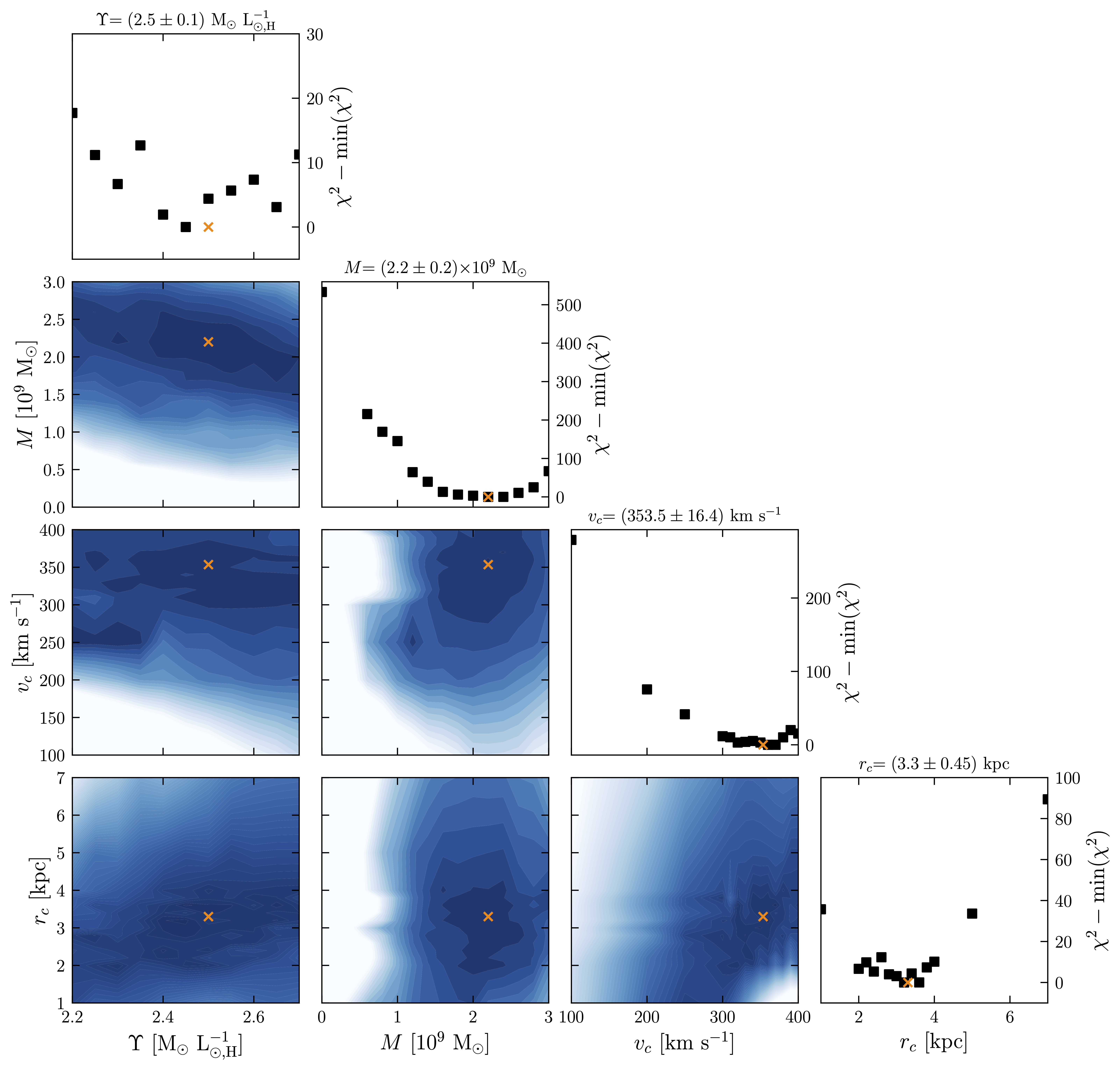
We present a stellar dynamical mass measurement of the supermassive black hole in the elliptical (E1) galaxy NGC 3258.
Our findings are based on integral field unit spectroscopy from the Multi Unit Spectroscopic Explorer (MUSE) observations
in narrow-field mode with adaptive optics and the MUSE wide-field mode, from which we extract kinematic information by
fitting the Ca II and Mg b triplets, respectively. Using axisymmetric, three-integral Schwarzschild orbit library models,
we fit the observed line-of-sight velocity distributions to infer the supermassive black hole mass, the H-band
mass-to-light ratio, the asymptotic circular velocity, and the dark matter halo scale radius of the galaxy.
We report a black hole mass of at an assumed distance of
31.9 Mpc. This value is in close agreement with a previous measurement from Atacama Large Millimeter/submillimeter
Array CO observations. The consistency between these two measurements provides strong support for both the gas dynamical
and stellar dynamical methods.
Thomas K. Waters, Colton Peterson, Razieh Emami, Xuejian Shen, Lars Hernquist, Randall Smith, Mark Vogelsberger, Charles Alcock, Grant Tremblay, Matthew Liska, John C. Forbes, and Jorge Moreno
We present an in-depth analysis of gas morphologies for a sample of 25 Milky Way-like galaxies from the IllustrisTNG TNG50
simulation. We constrain the morphology of cold, warm, hot gas, and gas particles as a whole using a Local Shell Iterative Method
(LSIM) and explore its observational implications by computing the hard-to-soft X-ray ratio, which ranges between
10-3–10-2 in the inner ~50 kpc of the distribution and 10-5–10-4 at the outer portion of the hot gas
distribution. We group galaxies into three main categories: simple, stretched, and twisted. These categories are based on the radial
reorientation of the principal axes of the reduced inertia tensor. We find that a vast majority (77%) of the galaxies in our sample
exhibit twisting patterns in their radial profiles. Additionally, we present detailed comparisons between 1) the gaseous distributions
belonging to individual temperature regimes, 2) the cold gas distributions and stellar distributions, and 3) the gaseous distributions
and dark matter (DM) halos. We find a strong correlation between the morphological properties of the cold gas and stellar distributions.
Furthermore, we find a correlation between gaseous distributions with DM halo that increases with gas temperature, implying that we may
use the warm-hot gaseous morphology as a tracer to probe the DM morphology. Finally, we show gaseous distributions exhibit significantly
more prolate morphologies than the stellar distributions and DM halos, which we hypothesize is due to stellar and AGN feedback.
Contact